9 Best Budget Trail Cameras (October 2026)
The best budget trail cameras include the Moultrie Edge 3 Cellular Trail Camera for remote buck alerts, the GardePro A3S Non-Cellular Trail Camera for basic SD card scouting, and the GardePro E6 WiFi Trail Camera for nearby phone viewing.
On this page (5 sections)
The GardePro A3S is the best budget trail camera for most buyers who want straightforward SD card scouting, with no-glow night vision, a fast trigger and an in-camera screen. Choose the Meidase P70 to review footage in the field, or the MAXDONE for solar-assisted phone access at close range.
Budget trail cameras span three different setups: local SD card storage, short-range phone connections and cellular photo delivery. Decide how you want to retrieve images before comparing resolution or extra features.
For a broader overview of camera types, see our plain buying guide to game cameras. If phone access is the main draw, our guide to trail cameras that connect to your phone explains the difference between local WiFi and cellular connections.
Our picks at a glance
-
1

-
2
 Best for basic SD card scouting
GardePro A3S Non-Cellular Trail Camera
8.2/10 our score
See it on Amazon -
3
- 4
 Check it
Meidase P70 Non-Cellular Trail Camera
Best for reviewing footage in the field - 5
 Check it
Stealth Cam Revolver Pro 2.0 360 Cellular Camera
Best for wide-area cellular coverage - 6
 Check it
Stealth Cam Fusion Max 3.0 Cellular Camera
Best for dual-carrier scouting - 7
 Check it
MAXDONE 4K Solar WiFi Trail Camera
Best for solar-assisted phone access - 8
 Check it
SPYPOINT Force-4K Non-Cellular Trail Camera
Best for 4K footage on an SD card - 9
 Check it
Browning Defender Pro Scout Max Cellular Camera
Best for dual-carrier cellular setup
How we chose these budget trail cameras
We compared connection type, capture features, storage and power options to find the best budget trail camera for different scouting needs. Our score weighs specs and features against what you're shopping for.
We checked which models store footage locally, which connect directly to a nearby phone and which can send images over cellular service. We also considered included storage, optional solar support, onboard screens and details that affect setup.
A feature only helps if it fits your property and routine. A nearby WiFi connection won't deliver remote alerts from miles away, and cellular access adds service needs that a basic SD camera avoids.
Which budget trail camera suits your setup?
The GardePro A3S is the best fit for basic SD card scouting, while the other models suit buyers who need phone access, solar power or cellular alerts. Compare the retrieval method first, then decide which features matter at your camera location.
Moultrie Edge 3 Cellular Trail Camera: Best for remote buck alerts
- Four-carrier auto-connect
- 40MP photos and 1080p video
- AI buck detection
- Live Aim and built-in GPS
Cellular photo alerts and AI buck detection suit hunters who want remote updates. It also offers Live Aim and built-in GPS for setup and camera location.
Pros
- Four-carrier auto-connect
- AI buck detection
- Live Aim and GPS
Cons
- Remote delivery uses cellular service
- Lithium battery packs and solar panels are separate
The Moultrie Edge 3 is the top pick for remote buck alerts because it combines cellular delivery with AI buck detection. Moultrie says its system can identify bucks and send high-resolution photos or HD video to the app.
Its four-carrier auto-connect is designed to select the strongest available network among four major U.S. carriers. The camera also offers 40MP photos, 1080p video, low-glow infrared, Live Aim and built-in GPS.
Moultrie plans start at 9 dollars.99, so account for ongoing service when comparing total cost. The Edge 3 is compatible with EDGE Series lithium battery packs and solar panels, sold separately.
Choose it if remote alerts matter more than avoiding a service plan. If you'd rather retrieve images during a camera visit, the GardePro A3S offers local storage without cellular or WiFi.
GardePro A3S Non-Cellular Trail Camera: Best for basic SD card scouting
- 64MP photos and 1296P video with sound
- 0.1-second trigger
- 940nm no-glow infrared
- Supports SD cards up to 512GB
The A3S keeps scouting simple with local SD card storage and no phone connection. It includes a screen for setup and playback, while batteries and the card are separate.
Pros
- Fast 0.1-second trigger
- No-glow night vision
- In-camera playback
Cons
- No remote phone access
- Batteries and SD card are not included
The GardePro A3S is the best budget trail camera for straightforward SD card scouting. It records 64MP photos and 1296P video with sound, then saves captures locally for you to retrieve.
A 0.1-second trigger and 120-degree PIR detection angle suit active trails where animals may pass quickly. Its 940nm no-glow infrared is designed to keep night illumination out of visible sight.
The built-in 2.4-inch color screen supports setup and playback without a separate phone connection. The camera takes 8 AA batteries and a full-size SD card, both sold separately, and supports cards up to 512GB.
Pick it if you want a camera without a phone connection. It supports an optional GardePro SP350 solar panel, but the panel is separate, so compare that extra power option with your expected camera visits.
For a closer model comparison, read GardePro A3S vs E5S. If battery life is part of your budget calculation, see our guide to trail camera batteries.
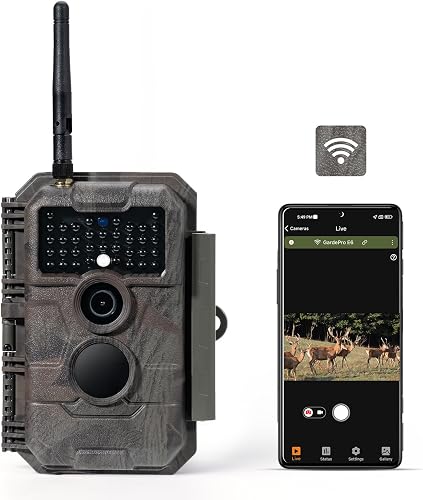
GardePro E6 WiFi Trail Camera: Best for nearby phone viewing
- Direct phone connection by Bluetooth and camera WiFi
- Connection range up to 45 ft in open areas
- 64MP photos and 1296P video
- Supports optional solar panel
The E6 lets you preview and manage files from a nearby phone without removing the camera. It does not connect to a home router or cellular network.
Pros
- Phone access within camera WiFi range
- No monthly fee
- No-glow infrared
Cons
- No remote access from outside its range
- Batteries and SD card are separate
The GardePro E6 is best for checking captures on a nearby phone without removing the camera. It connects through Bluetooth and the camera's own WiFi, with a stated range of up to 45 ft in open areas.
This is not a home WiFi or cellular camera, so it won't send photos to you from another location. At close range, the app can preview, download and manage photos and videos, and the camera includes live view for aiming.
The E6 records 64MP photos and 1296P video, with a 110-degree field of view and 940nm no-glow infrared. It uses 8 AA batteries and supports the separate GardePro SP350 solar panel.
Choose it if your camera is close enough for a phone connection when you visit. If you need remote alerts, consider a cellular model and account for service needs.
Our guide to WiFi vs cellular trail cameras explains which connection type fits your setup.
Meidase P70 Non-Cellular Trail Camera: Best for reviewing footage in the field
- 64MP photos and 1296p video
- 0.1-second trigger
- 100 ft no-glow night vision
- 2.4-inch color display
A color screen and on-camera playback make it easier to check captures during a camera visit. The P70 stores footage locally and supports an optional solar panel.
Pros
- On-camera playback
- Fast 0.1-second trigger
- Solar-ready with optional panel
Cons
- No phone or remote access
- Batteries and SD card are not included
The Meidase P70 suits buyers who want to review captures right at the camera. Its 2.4-inch color display and on-camera playback help you check footage during a visit without a phone connection.
It records 64MP photos and 1296p video, and its 0.1-second trigger is designed to catch fast movement. The 100 ft no-glow night vision uses 940nm infrared LEDs.
The P70 stores images on an SD card and runs on 8 AA batteries, both sold separately. It supports cards up to 512GB and can use the separate Meidase SP350 solar panel, with AA batteries available as backup.
Pick it if you value on-site playback over remote access. That local setup avoids cellular service, but you still need to visit the camera to retrieve or review what it captured.
Stealth Cam Revolver Pro 2.0 360 Cellular Camera: Best for wide-area cellular coverage
- 360-degree field of view
- 40MP photos and 1440p video with audio
- 0.35-second trigger
- 32GB internal memory and built-in GPS
The 360-degree view can cover activity around the camera from a single mounting point. Cellular delivery and GPS add remote access and location tracking.
Pros
- 360-degree field of view
- 32GB internal memory
- Built-in GPS
Cons
- Remote delivery uses cellular service
- Weighs 2.4 lb
The Stealth Cam Revolver Pro 2.0 is the cellular pick for buyers who want a broad view from one camera. Its 360-degree field of view can capture activity around the mounting point, with 40MP photos and 1440p video with audio.
The camera has a 0.35-second trigger, a 100 ft detection and flash range, and 32GB of internal memory. Built-in GPS tracks the camera location, while AIO Carrier Determination and the Command PRO App support cellular management.
Its integrated multi-position mount and python cable provision offer mounting and security options. The camera weighs 2.4 lb.
Choose it when a wide area matters to your scouting. Cellular delivery means you should check service and plan details for your area before choosing it.
Stealth Cam Fusion Max 3.0 Cellular Camera: Best for dual-carrier scouting
- Dual-carrier cellular connectivity
- Up to 42MP photos and 1080p video
- 0.4-second trigger
- 16GB internal memory and GPS
Dual-carrier connectivity and built-in GPS suit remote monitoring across a hunting area. It also has internal memory, with solar accessories sold separately.
Pros
- Dual-carrier connectivity
- Built-in GPS
- Internal memory
Cons
- Remote delivery uses cellular service
- Solar accessories are separate
The Stealth Cam Fusion Max 3.0 suits buyers who want cellular scouting with dual-carrier connectivity. It supports up to 42MP photos, 1080p video, built-in GPS and the Command PRO App.
Its motion sensor has a stated detection distance of up to 100 ft and a 0.4-second trigger. The camera includes 16GB of internal memory and a 16-cell battery tray, with support for lithium batteries and separate solar accessories.
Photo and video on demand add remote capture options, while the integrated mount has a Python cable latch provision. Plan for cellular service and confirm that the app and coverage meet your needs before setting it up.
Pick it if remote monitoring and internal storage fit your needs. For a simpler setup that saves locally, the Force-4K avoids cellular service.
MAXDONE 4K Solar WiFi Trail Camera: Best for solar-assisted phone access
- Built-in rechargeable battery and detachable solar panel
- 64MP photos and 4K video
- Phone connection up to 55 ft in open areas
- 32GB Micro SD card included
The MAXDONE combines a solar panel, rechargeable battery and phone access at close range. Its camera creates its own WiFi and does not connect to a home router.
Pros
- Solar panel and rechargeable battery
- Micro SD card included
- Phone connection up to 55 ft in open areas
Cons
- Phone access is limited to the camera's range
- Night vision uses 850nm infrared LEDs
The MAXDONE is the solar-assisted pick for phone access near the camera. It has a built-in rechargeable battery and a detachable, adjustable solar panel, plus Bluetooth and camera WiFi for phone transfers up to 55 ft in open areas.
It records 64MP photos and 4K video, and includes a 32GB Micro SD card. The camera creates its own WiFi connection and does not connect to a home WiFi router, so phone access remains local.
Its low-glow infrared uses 850nm LEDs, and the camera offers scheduled shooting and time-lapse modes. It also supports connection to a power bank for continued power.
Choose it if you want a rechargeable solar setup and nearby phone access. If you want simple SD card storage without a phone connection, the A3S or Force-4K may fit better.
For more options, compare our best solar trail cameras and best WiFi trail cameras.
SPYPOINT Force-4K Non-Cellular Trail Camera: Best for 4K footage on an SD card
- 4K video with sound
- 48MP photos
- 66-degree field of view
- 2-inch color LCD screen
The Force-4K records locally and includes a screen for viewing media and adjusting settings. It suits buyers who want high-resolution video without cellular service.
Pros
- 4K video with sound
- On-camera LCD screen
- No cellular service needed
Cons
- SD card is separate
- No remote photo delivery
The SPYPOINT Force-4K suits buyers who want high-resolution local video without cellular service. It captures 4K video with sound and 48MP photos, then saves the files to an SD card.
A 66-degree field of view gives a narrower view than the 360-degree cellular Revolver Pro 2.0. Its 2-inch color LCD screen lets you configure settings and view media at the camera.
The SD card is not included, and this model does not provide cellular photo delivery. Its non-cellular setup means you need to visit to retrieve or review captures.
Pick it if you want 4K video and can check the camera in person. If phone transfers matter more, a short-range WiFi model such as the GardePro E6 is a better match.
Browning Defender Pro Scout Max Cellular Camera: Best for dual-carrier cellular setup
- Pre-installed AT&T and Verizon SIM cards
- 22MP images and 1080p video with sound
- 0.25-second trigger
- GPS-tagged images
The Defender Pro Scout Max offers two carrier options and GPS-tagged images. Its cellular features suit buyers who want captures sent to a phone.
Pros
- Two pre-installed SIM cards
- Fast 0.25-second trigger
- GPS-tagged images
Cons
- Remote delivery uses cellular service
- Check service plan details for your location
The Browning Defender Pro Scout Max is a cellular option for buyers who want two carrier choices. It comes with pre-installed AT&T and Verizon SIM cards and can auto-detect the carrier with the stronger signal in the field.
It captures 22MP images and full HD 1080p video with sound. Other features include a 0.25-second trigger, adjustable infrared flash up to 120 ft and GPS-tagged images.
The camera's cellular delivery can help you check activity without retrieving an SD card, but it still depends on coverage and a service plan. Confirm service plan options and compatibility for your location before you buy.
Choose it if dual-carrier support and GPS-tagged images suit your scouting routine. If you want to avoid service needs, compare it with a non-cellular model that stores captures locally.
How do you choose a budget trail camera?
Choose a budget trail camera by deciding how you'll retrieve images, how often you can visit the site and what power setup fits the location. Those choices matter more than a large resolution number by itself.
Is local SD storage enough?
A non-cellular camera is a good fit if you can visit the site to retrieve its SD card or review footage on the camera. The GardePro A3S and Meidase P70 both use local storage and include a screen for setup or playback.
A local camera avoids a cellular plan, but regular visits take time. Choose a supported card size that gives you room for your expected photo and video activity, and check captures before the card fills.
Will WiFi reach your trail camera?
A WiFi trail camera is useful when you can stand near it and connect your phone directly. The GardePro E6 states a range up to 45 ft in open areas, while the MAXDONE states up to 55 ft.
These cameras create a local connection rather than joining a home router. Trees, terrain and structures can limit the range, so keep the camera within reach when you plan to use the app.
When is cellular worth the extra cost?
Cellular makes sense when you want photos sent to your phone without visiting the camera. Check coverage at the exact property and account for service plans before choosing a model.
For a deeper look at network and plan considerations, read cellular trail cameras: plans, carriers and what to buy. Our guide on whether cellular trail cameras are worth the cost can help you weigh remote access against local retrieval.
Which power and storage costs should you count?
Count the batteries, memory card and solar accessories you need, since some cameras include none of those items. A camera with a low upfront cost can require extra gear before you can use it.
The GardePro A3S, GardePro E6 and Meidase P70 each use 8 AA batteries, and their SD cards are separate. The MAXDONE includes a Micro SD card and detachable solar panel, while the SPYPOINT Force-4K needs a separate SD card.
Solar support varies by model. The A3S and E6 support a separate GardePro SP350 panel, and the P70 supports a separate Meidase SP350 panel.
For camera security and placement, use our guide to securing a trail camera from theft. A camera that's easy to retrieve or protect can save more hassle than a feature you rarely use.
Which budget trail camera should you choose?
Choose the GardePro A3S if you want a local camera with a fast trigger, no-glow infrared and an onboard screen. Pick the Meidase P70 for field playback, the MAXDONE for solar-assisted phone access nearby, or a cellular model if remote alerts are worth the service needs.
If remote cellular access is your priority, compare the plan and carrier details with the camera features before deciding. For local scouting, choose the storage and power setup that fits how often you can visit the camera.
Our top 3 picks at a glance
-
1
-
2
Best for basic SD card scouting
GardePro A3S Non-Cellular Trail Camera
8.2/10 our score
See it on Amazon -
3
Frequently asked questions
What should you look for in a budget trail camera?
Start with the connection type, power needs and storage. A basic non-cellular camera stores captures on an SD card, while WiFi models usually need you close by to transfer files and cellular cameras can send them remotely.
Check whether batteries, a memory card or a solar panel are included before choosing.
Are non-cellular trail cameras cheaper to run?
They can be, because they don't need a cellular plan to send photos. You retrieve the SD card or view files on the camera, so factor in the time and travel needed to check it.
Battery use still depends on trigger activity, settings and conditions.
Can a WiFi trail camera connect to your home router?
Usually, no. Models such as the GardePro E6 create a short-range connection between the camera and your phone, rather than joining a home router.
Check the connection method and range before buying if you expect remote access.
Do budget trail cameras need a solar panel?
No. Many run on AA batteries, while some support a separate solar panel or include one.
Solar power can reduce battery changes when the panel gets suitable light, but it does not remove the need to check camera settings, storage and power.
How much storage do you need for a trail camera?
It depends on how often the camera triggers and whether it records video. A camera that supports a large SD card gives you more room, but the card may be sold separately.
Check the supported card type and maximum capacity, then review captures often enough to avoid filling it.


