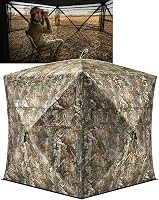
8 Best Ground Blinds (October 2026)
The best ground blinds for hunting include the Ameristep Doghouse Run and Gun Ground Blind for mobile pairs, the Ameristep Care Taker Ground Blind for wooded pairs, and the Ameristep Brickhouse 3-Person Ground Blind for hunting groups.
On this page (3 sections)
The Ameristep Doghouse Run and Gun is the best ground blind for most mobile two-person hunts. It is designed for two hunters, packs into a backpack carrying case and has multiple windows and gun ports.
Choose the Care Taker if you want integrated wheels and a smaller footprint, or the Brickhouse if your group needs room for up to three hunters. A tent chair blind makes more sense when you're hunting alone and want a seat attached to your concealment.
A ground blind should fit the way you hunt, not just the number of people in your party. Compare usable space, height, window layout and carry method, then check the site for roots, brush and level ground.
If you're deciding between a pop-up blind and another concealment style, start with our guide to hunting blinds and what to know before you buy. For options across blind styles, see the best deer blinds.
Our picks at a glance
-
1

-
2

-
3
 Best for hunting groups
Ameristep Brickhouse 3-Person Ground Blind
8.0/10 our score
See it on Amazon
- 4
 Check it
Ameristep 1-Person Tent Chair Blind
Best for solo carrying - 5
 Check it
Rhino R100 2-Person Ground Blind
Best for taller pairs - 6
 Check it
Ameristep Deluxe Tent Chair Blind, 2 Seats
Best for shared seating - 7
 Best for broad viewsCheck it
- 8
 Check it
Rhino Valley 360 See-Through Blind
Best for all-around viewing
Which best ground blind fits each kind of hunt?
The Doghouse Run and Gun suits a portable two-person setup, while the Care Taker trades some floor space for integrated wheels. These picks also cover solo hunters, groups and buyers who want a particular window arrangement.
Ameristep Doghouse Run and Gun Ground Blind: Best for mobile pairs
- Designed for 2 hunters
- 60 x 60 in footprint
- 12 lb weight
- Backpack carrying case, tie-downs and ground stakes
A spring steel blind designed for two hunters with quick setup, a backpack carrying case and multiple window openings. Its footprint gives you a clear size to compare with a planned site.
Pros
- Backpack carrying case
- Multiple windows and gun ports
- Tie-downs and ground stakes included
Cons
- Footprint needs a suitable site
- Two-person capacity may be tight with bulky gear
The Doghouse Run and Gun suits a pair who needs to carry a blind into position. Its spring steel design is made for quick setup and takedown, and the backpack case keeps the blind with its carry gear.
The 60 x 60 in footprint gives two hunters a clear space to plan around. Multiple windows and gun ports let you choose openings for the site, while the included shoot-through mesh covers add options for the windows.
The matte Durashell Plus exterior and 3D Edge ReLeaf trim are designed to break up hard edges. Ameristep's ShadowGuard interior coating helps reduce visible shadows and silhouettes.
Choose it for mobile two-person hunts where the carry case and quick setup suit your route. Skip it if you need room for three people or bulky equipment, or if your access path cannot fit the packed blind.
Ameristep Care Taker Ground Blind: Best for wooded pairs
- Designed for 2 hunters
- 55 x 55 in footprint
- Integrated wheels
- Silent toggle window system
The Care Taker pairs two-person capacity with a smaller footprint and integrated wheels. Its silent toggle windows suit hunters who want to adjust openings quietly.
Pros
- Smaller footprint than many two-person hub blinds
- Integrated wheels for transport
- High-wind tie-downs included
Cons
- Footprint leaves limited gear space
- Check dimensions against your preferred seating
The Care Taker suits hunters who want to move a two-person blind without carrying it. Integrated wheels help with transport, and its 55 x 55 in footprint works where a larger blind would be difficult to place.
Silent toggles operate the window system, and the blind includes high-wind tie-downs and ground stakes. The Durashell Plus shell and black ShadowGuard interior provide concealment features.
The compact size can help in heavily wooded areas, but it leaves less room for two hunters' equipment. Decide where each person will sit and where packs will go before committing to the footprint.
Pick it for a compact shared setup that benefits from wheels. Skip it if you want generous interior space or a flexible layout for bulky seats and gear; compare it with the Ameristep Brickhouse if your group needs a different arrangement.
Ameristep Brickhouse 3-Person Ground Blind: Best for hunting groups
- Capacity for up to 3 hunters
- 10 windows with shoot-through mesh
- 59 x 59 in footprint
- Brush loops
The Brickhouse offers room for up to three hunters and 10 windows with shoot-through mesh. Brush loops let you add natural foliage around the blind.
Pros
- Capacity for up to 3 hunters
- 10 windows with shoot-through mesh
- Brush loops for optional foliage
Cons
- Needs adequate site space
- Three-person capacity leaves less elbow room with bulky gear
The Brickhouse is the group pick, designed for up to three hunters. Its 10 windows with shoot-through mesh offer opening choices, and brush loops provide places to add natural foliage.
Its 59 x 59 in footprint gives you a size to check against the site. The Spider Hub frame and Durashell Plus exterior support a portable hub-style setup, while the ShadowGuard coating helps reduce interior shadows and silhouettes.
Three-person capacity does not mean three hunters have unlimited room for gear. Plan seats, packs and shooting positions before the hunt, especially if everyone carries a full pack.
Choose it when sharing a blind matters more than keeping the setup small. Skip it if your site is cramped or you need a roomy interior for three hunters and bulky gear.
Our guide to ground blind size can help you plan the layout.
Ameristep 1-Person Tent Chair Blind: Best for solo carrying
- One-person design
- 30-second setup
- Carrying case with shoulder strap
- Designed for firearm and crossbow hunters
This tent chair blind combines a seat and concealment in a single piece of gear. Its one-person design suits a solo hunter who wants fewer separate items to carry.
Pros
- Chair and blind in one setup
- Carrying case with shoulder strap
- No assembly required
Cons
- Designed for one hunter
- Not as roomy as a hub blind
The Ameristep 1-Person Tent Chair Blind suits a solo hunter who wants a seat and concealment in one unit. Its setup is described as taking 30 seconds, and it includes a carrying case with a shoulder strap.
Its Durashell Plus shell has a matte finish, and Mossy Oak Break-Up Country trim is designed to break up hard edges. Ameristep's ShadowGuard coating helps reduce shadows and silhouettes inside.
A tent chair keeps the setup simple, but there is no room for a second hunter. Check that your other gear can stay outside without blocking your movement or shot.
Choose it when you hunt alone and want a seat attached to the blind. Skip it if you need open floor space, adjustable seating or room for a partner.
Rhino R100 2-Person Ground Blind: Best for taller pairs
- Fits 2 people
- 63 x 63 in hub-to-hub size
- 65 in center height
- 150 denier polyester
The R100 gives two hunters a 63 x 63 in hub-to-hub size and 65 in center height. Its carry bag, stakes and rod-and-hub system support a portable setup.
Pros
- 63 x 63 in hub-to-hub size
- 65 in center height
- Stakes and carry bag included
Cons
- Usable floor space is 49.5 x 49.5 in
- Site needs room for its wider hub-to-hub footprint
The Rhino R100 gives two hunters a 63 x 63 in hub-to-hub size and 65 in center height. Its usable floor space is 49.5 x 49.5 in, so plan seating and gear around that smaller measurement.
Rhino describes a rod-and-hub setup that can be put up quickly with practice. The blind includes stakes and a bag, and it uses 150 denier polyester.
The difference between the outside size and floor space matters if two hunters bring packs or bulky seats. Lay out your intended setup at home or mark the floor dimensions before choosing this blind.
Consider the R100 if its center height and included carry gear suit your plans. Skip it if the smaller usable floor leaves too little room for your seats and equipment.
For trail camera placement around a hunting route, see where to place trail cameras.
Ameristep Deluxe Tent Chair Blind, 2 Seats: Best for shared seating
- Integrated chair with 2 seats
- 52 x 61 x 60 in dimensions
- 30-second setup
- Carrying case with strap
The Deluxe Tent Chair Blind combines concealment with an integrated two-seat chair. It fits hunters who value a ready-to-use seat over the flexible interior of a hub blind.
Pros
- Two integrated seats
- No assembly required
- Designed for firearm and crossbow hunters
Cons
- Fixed chair layout limits seating options
- 17 lb weight matters on longer carries
The Deluxe Tent Chair Blind combines concealment with a chair that has two seats. Its 52 x 61 x 60 in dimensions give two hunters a fixed seating arrangement rather than the open interior of a hub blind.
It is designed for firearm and crossbow hunters and comes with a carrying case and strap. The 30-second setup and no-assembly design make it a ready-to-use option when you want the seating built in.
A fixed chair layout can limit how you position equipment or shift during a hunt. Its 17 lb weight is worth considering if your route includes a long carry.
Pick it when two integrated seats matter more than rearranging the interior. Skip it if you want separate seats, open floor space or a lighter carry for a long walk.
Barronett Ace 250 Hub Blind: Best for broad views
- 75 x 75 in footprint
- 67 in height
- Adjustable panoramic front window
- Detachable blaze orange safety panels
The Ace 250 offers a broad footprint, an adjustable panoramic front window and rear peek windows. Its shoot-through mesh is for fixed-blade broadheads.
Pros
- Panoramic front shooting window
- Rear peek windows
- Detachable blaze orange safety panels
Cons
- Needs a larger site
- Shoot-through mesh is specified for fixed-blade broadheads
The Barronett Ace 250 provides a 75 x 75 in footprint and an adjustable panoramic front shooting window. Rear peek windows add viewing options, and brush holders allow optional natural concealment.
The blind includes detachable blaze orange safety panels for gun hunting season, plus a carry bag, stakes and tie-down ropes. Its shoot-through mesh is specified for fixed-blade broadheads, so match your equipment to that use.
The broad footprint needs a roomy site, and the blind weighs 15 lb. Check the walk-in route and available setup area before deciding that the larger layout is practical.
Choose the Ace 250 for a wide front view and broad floor area. Skip it if your site is tight or its mesh does not match your equipment.
Rhino Valley 360 See-Through Blind: Best for all-around viewing
- Four one-way mesh panels
- 58 x 58 x 66 in dimensions
- Double-sided opening
- Stakes and carrying bag included
Four one-way mesh panels provide views around the blind, and its double-sided opening adds another way to enter or exit. It can accommodate 2–3 hunters.
Pros
- Four see-through mesh panels
- Double-sided opening
- Carrying bag and stakes included
Cons
- Newer product with limited buyer feedback
- Check local rules for see-through blind use
The Rhino Valley blind stands out for its four one-way mesh panels, which provide views around the blind. It measures 58 x 58 x 66 in and has a double-sided opening.
It can accommodate 2–3 hunters, and the package includes a carrying bag and stakes. The outer fabric is described as waterproof and flame retardant.
Check local rules before choosing a see-through blind. Visibility requirements, blaze orange rules and local conditions can affect whether this design suits your hunting area.
Choose it if wide-angle viewing and two-sided entry fit the way you hunt. Skip it if you prefer an opaque exterior or need more established buyer feedback before deciding.
How do you choose the best ground blind for your setup?
Choose a ground blind by matching its usable floor space, height and window layout to your hunting party and gear. Then check the packed size and carry method against the distance and route to your site.
How many people fit inside a best ground blind?
A one-person tent chair is made for a solo setup, while hub blinds in this group are designed for two or up to three hunters. Capacity is only a starting point because seats, packs and equipment also take up floor space.
For two hunters, compare stated interior or floor dimensions where available. The Rhino R100, for example, has a 63 x 63 in hub-to-hub size but a 49.5 x 49.5 in floor space.
If you hunt with a partner and want dedicated seating, consider the Ameristep Deluxe Tent Chair Blind. For a more flexible interior, a hub blind lets you bring and position separate seats.
How much room does a ground blind need?
Measure a clear patch that fits the blind's footprint, plus room to open windows and move around it. A 75 x 75 in model like the Ace 250 needs more site space than a 55 x 55 in Care Taker.
Look for level ground and clearance from branches, rocks and travel paths. A blind can be hard to position if its footprint crowds the route or leaves no room to secure the corners.
Set up the blind before your hunt when you can, and check that the chosen windows face useful lanes. For timing advice, read when to set up a ground blind.
Which windows on a ground blind suit your equipment?
Window layouts range from multiple openings and gun ports to a panoramic front window or see-through mesh panels. Match the opening to how you plan to observe and shoot, and follow the blind's instructions for any shoot-through mesh.
The Ace 250 mesh is specified for fixed-blade broadheads. Ameristep describes mesh windows for firearm and crossbow use on several models, but confirm the instructions for the exact blind and equipment combination.
A see-through blind can provide broad views, but local rules may limit its use. Check regulations before hunting, especially where visibility or blaze orange requirements apply.
How should you set up and secure a ground blind?
Set a blind on level ground, orient its openings toward useful viewing or shooting lanes, and secure it with the included stakes and tie-downs when available. Check the site and the blind's instructions before you leave it in place.
Keep fabric clear of branches and make sure the doors and windows can move without catching. Arrange seats and gear before the hunt so you are not shifting the layout after settling in.
The Doghouse includes tie-downs and stakes, while the Ace 250 includes stakes and tie-down ropes. The Care Taker also includes high-wind tie-downs, so use those parts as directed.
Inspect the blind for loose fabric or movement after wind or rain. A blind that flaps or shifts can draw attention and may become unsafe; read how to stake down a ground blind before leaving one set up.
What mistakes should you avoid with a ground blind?
The most common buying mistake is treating capacity as a promise of comfort. A blind designed for two or three people may still feel crowded once you add seats, packs and equipment, so plan the interior before you buy.
Another mistake is comparing only outside dimensions. The R100's hub-to-hub size is larger than its usable floor, which makes the interior measurement more helpful for seating plans.
Don't assume every mesh window supports every weapon or shot type. Check the specific blind's instructions, then follow local hunting rules before shooting through mesh.
Finally, don't choose a blind by its window layout without checking the site. A panoramic front window or all-around viewing panels only help if the blind fits securely and faces the area you need to observe.
How do you care for and store a ground blind?
Care depends on the blind's materials and instructions, so follow the care guidance for the exact model. The Brickhouse specifies spot cleaning, while the Rhino Valley blind specifies hand washing.
Before packing, remove loose dirt and let damp fabric dry as directed by the maker. Check the fabric, hubs, windows, stakes and tie-downs for damage or wear, and store small parts with the blind so they're ready for the next setup.
Keep the packed blind in its case when one is included. Avoid forcing a hub or spring frame into a folded position if it resists; return to the model's setup instructions instead.
Which best ground blind should you choose?
Choose the Doghouse Run and Gun for a portable two-person setup, the Care Taker for integrated wheels and a compact footprint, or the Brickhouse when you need capacity for up to three hunters. Solo hunters who want a seat built in should choose the one-person tent chair.
Pick the Ace 250 if its panoramic front view and larger footprint match your site. Choose the Rhino Valley if all-around viewing and two-sided entry suit your location and local rules.
If you want to compare blind types before choosing a model, revisit our guide to hunting blinds. For deer-focused options across more styles, see the best deer blinds.
Our top 3 picks at a glance
-
1
-
2
-
3
Best for hunting groups
Ameristep Brickhouse 3-Person Ground Blind
8.0/10 our score
See it on Amazon
Frequently asked questions
What size ground blind should I choose?
Choose a ground blind that fits the hunters, seats and gear you plan to bring, then check its footprint against the available site. A 55 x 55 in blind may suit a compact two-person setup, while a 75 x 75 in model needs more clear ground.
Check interior floor space when it is available, since hub-to-hub dimensions can be larger.
Is a hub blind or a tent chair blind better?
A hub blind gives you an open interior you can arrange with separate seats, while a tent chair combines a seat and concealment. Pick a hub model for flexible seating or more than one hunter, and a tent chair when a compact solo setup matters.
Compare packed weight and carry style if you expect a long walk.
Can you shoot through a ground blind's mesh?
Only use shoot-through mesh for the equipment and shot type the blind supports. Barronett specifies that the Ace 250 mesh is for fixed-blade broadheads, while several Ameristep models describe mesh windows for firearm and crossbow hunting.
Read the blind's instructions and follow local hunting rules before taking a shot through mesh.
Should you leave a ground blind set up?
You can leave a blind set up when the location, weather and local rules allow it, but secure it with the included stakes and tie-downs where available. Wind can move a blind or make fabric flap, so inspect it before each hunt.
Our guide to staking down a ground blind covers the basic setup checks.